Talk to my AI clone
Ask about my work, or how to get into voice AI: roadmaps, internships, jobs, tips. It only knows what's on this site.
You're talking to an AI, not me. Calls end after 5 minutes or 45 seconds of silence. The transcript stays in your browser; this site doesn't record calls.
About
I lead the AI & real-time stack behind InCruiter's voice interviewers, scaled to 1,000+ concurrent interviews in 42+ languages. In production I root-caused why multilingual interviews broke: English-only text guards failed on Devanagari (0.39 vs a 0.5 match threshold) and Marathi STT hallucinated in 10 of 15 turns, then shipped script-aware, feature-flagged fixes.
Now I'm rebuilding the speech stack from the papers up, starting with Hindi and Marathi, and fixing the frameworks voice agents run on: 16 merged PRs, 7 of them in LiveKit. Before InCruiter I built WhatsApp automation and real-time voice agents at Anantkamal Software Labs in Nashik, and worked as an AI engineer at myRide (Boston, remote) on autonomous-vehicle rule validation. Also a 9× hackathon winner.
Work Experience
Education


Skills
Voice AI playbook
What breaks real voice agents, and what I do about each. Every card points at production work or at code you can read.
Phone calls, not just browsers
PSTN calls over Twilio and Exotel with Vapi orchestrating STT → LLM → TTS, call events over webhooks, voicemail detection so the agent never interviews an answering machine.
Interruptions and barge-in
Callers can cut in, but a cough or an “hmm” doesn't kill the sentence: a false interruption resumes the reply after 1 s. Fixed cut-off speech on Hindi calls.
STT mishears names and jargon
Keyterm prompting: product names, people and tech words are pushed into Deepgram nova-3 keyterms and Sarvam's prompt, so “InCruiter” stops coming back as something else.
Hindi, Marathi and Hinglish in one call
STT auto-detects the language; the voice is picked from the reply itself (Hindi and Marathi share Devanagari, so marker words decide), and each language has its own TTS chain.
Guards that only read English
Script-aware, feature-flagged matching after an English-only guard scored a correct Devanagari answer 0.39 against a 0.5 threshold. Diagnosed Marathi STT hallucinating in 10 of 15 turns.
Providers fail mid-call
Every stage has a fallback chain: three STT engines, three LLMs, a TTS chain per language. A rate limit mid-call moves to the next model and the call carries on.
Latency that compounds
Per-stage latency budgets, streaming everywhere, preemptive generation that starts the reply before the turn is final, one 24 kHz format across voices.
LLMs that ramble or make things up
Voice-specific prompting: hard word cap with a server-side trim, markdown and emoji stripped before TTS, scope lock, prompt-injection resistance, no invented facts, AI disclosure.
Noisy rooms and echo
Krisp noise cancellation on the caller's audio in the agent, echo cancellation and auto gain in the browser.
Cost and abuse on a public agent
One-minute mic-only tokens bound to this site's origin, per-IP rate limit, 5-minute cap, hang-up after 45 s of silence, no call recording.
What I'm shipping
Two voice agents in production at InCruiter, the one you can talk to on this page, and the stack I'm building next. Every badge is honest: numbers on unfinished work are targets, not results.
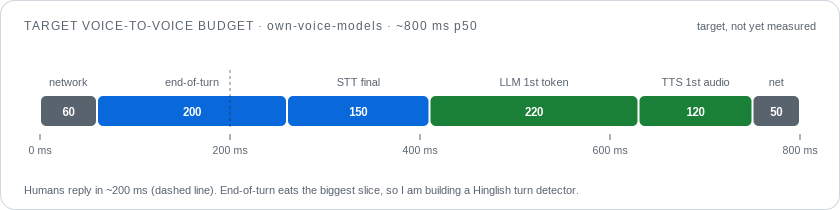
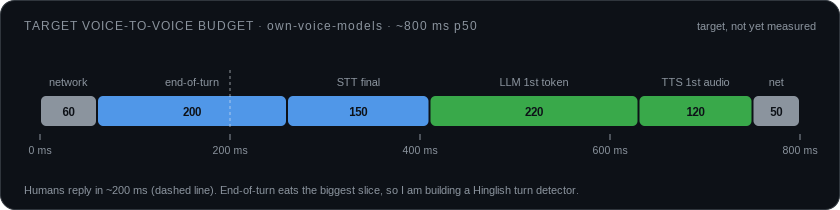
Own Voice AI Models
STT · LLM · TTS · real-time orchestratorMy own Hindi/Marathi ASR and TTS models and a LoRA-tuned LLM, joined by a from-scratch streaming orchestrator (VAD, end-of-turn, barge-in); ONNX, INT8, speculative decoding.
Target: ~800 ms p50 voice-to-voice, ~5× lower cost/min than hosted APIs.
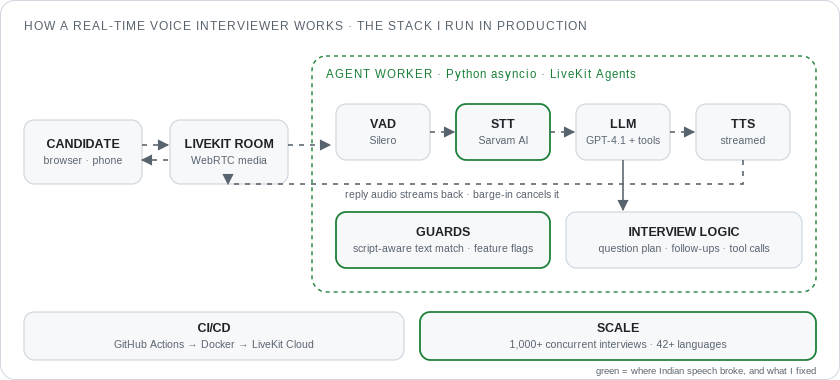
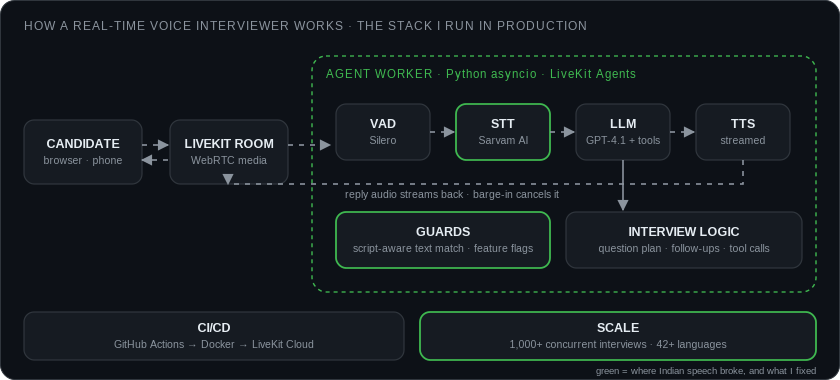
STT → LLM (tool calling) → TTS interviewer with feature-flagged guards; Docker CI/CD to LiveKit Cloud via GitHub Actions; runs in 42+ languages.

Built from scratch: AI screening phone calls over Twilio and Exotel telephony, orchestrated with Vapi, plus WhatsApp interviews. Multilingual question sets, 7 Hindi voices, voicemail detection and fluency scoring. Hindi call-quality work: replies took ~5 s vs ~2 s in English, plus cut-off speech and interruptions.
Talks in English, Hindi or Marathi and switches when you do. Three-deep fallback chains for STT, LLM and TTS; keyterm-prompted STT; per-reply voice routing (Hindi and Marathi share a script, so it reads the reply's words); false-interruption recovery; Krisp noise cancellation; hangs up on silent callers. Five Python files, deployed to LiveKit Cloud by GitHub Actions.
IndicVoiceBench
Benchmark for voice agents on Indian speechRanks STT/TTS models (Sarvam, ElevenLabs, Deepgram, Cartesia, OpenAI, Whisper) on Hindi, Marathi and Hinglish phone audio: WER, time-to-first-byte, MOS; public leaderboard.
Target: 10+ models benchmarked.
Hinglish Turn Detector
Code-mixed end-of-turn modelSmall transformer trained on Hinglish/Marathi dialogue (after VAP), shipped as a LiveKit Agents plugin.
Target: ~30% fewer false interruptions than VAD-only.
indic-guard
Script-aware text matchingFuzzy-matches Devanagari, romanized and code-mixed text; born from the 0.39-vs-0.5 production bug.
Target: published on PyPI.
Bhasha Bridge
Real-time translated phone calls · मराठी ⇄ EnglishCall any Indian number: each side hears the other in their own language and cloned voice (LiveKit SIP, STT → IndicTrans2 → F5-TTS).
Target: ~2 s end-to-end.
Prompt-Injection Guard for Voice Agents
Red-teaming with spoken attacksRed-team a voice agent with spoken attacks; a guard model blocks them.
Target: 200+ spoken attacks tested.
Writing
All notes →Fixes sent upstream
16 merged fixes in the frameworks voice agents run on, 7 of them in LiveKit. Each one started with a test that fails on main.
fix(api): report a missing sha256 claim in WebhookReceiver
✓ Merged · +10 −1 · 2 files
A webhook token without a body hash was rejected as "hash mismatch", because the verifier fills the missing claim with an empty string.
fix(api): keep the base path of the server URL in Twirp requests
✓ Merged · +75 −2 · 2 files
Since region failover, a server URL behind a reverse-proxy path lost its path, so every API call went to the wrong place.
fix(rtc): keep an AudioMixer input alive after a read timeout
✓ Merged · +189 −7 · 2 files
One late frame cancelled an async-generator input, which closed it: the mixer dropped the rest of that stream's audio.
fix(rtc): use the right plane layout for I420A, I422 and NV12 frames
✓ Merged · +69 −3 · 2 files
Chroma was sized width × width, so a 640×480 NV12 frame copied 512,000 bytes instead of 460,800 out of native memory.
fix(api): support the canSubscribeMetrics video grant
✓ Merged · +37 −0 · 2 files
Python couldn't mint the grant, and TokenVerifier silently dropped it from tokens minted by other SDKs.
fix: add the final period when a transcript ends in a vowel sign
✓ Merged · +38 −1 · 2 files
Hindi, Bengali and Tamil transcripts lost their full stop whenever the last letter carried a vowel sign (matra).
fix: don't crash feed_audio on a chunk too short to resample
✓ Merged · +24 −0 · 2 files
An empty or sub-sample audio chunk raised ZeroDivisionError into the caller's streaming loop.
fix: start the server with the client's empty language
✓ Merged · +32 −1 · 2 files
The client dropped language="", so an autostarted server fell back to English instead of auto-detecting.
fix: send ElevenlabsEngine voice settings with each request
✓ Merged · +60 −6 · 2 files
Stability, clarity and style were stored but never sent after the move to the streaming endpoint.
Split sentences at the Urdu full stop (۔)
✓ Merged · +37 −5 · 3 files
Urdu text streamed to TTS as one long sentence.
Let the nltk+rule-based tokenizer split at । 。 ؟ ۔
✓ Merged · +89 −0 · 2 files
The default tokenizer never split Hindi, Chinese, Arabic or Urdu text into sentences.
Don't add a space when joining short Chinese and Japanese sentences
✓ Merged · +50 −7 · 2 files
Merging short CJK sentences inserted a space that doesn't belong in those scripts.
Phonemize Hebrew in infer_torch instead of falling through to espeak-ng
✓ Merged · +132 −0 · 4 files
A Hebrew voice was checked with different phonemes than it was trained on, with no error.
fix(voice-sarvam): use the configured listening model in listen()
✓ Merged · +94 −4 · 3 files
SarvamVoice.listen() ignored the constructor's model, language and mode and always sent the defaults.
Rebuilding the stack from the papers up
14 reimplementations from scratch, adapted to Hindi and Marathi. 7 are public with code and measured numbers; the rest are planned, and each repo goes public when it ships.
Transformer
Vaswani et al. 2017 · public
English → Hindi on the IITB corpus: 12.7 sacreBLEU, 39.3 chrF2 on the WAT test set.
GPT + BPE Tokenizer
Radford et al. 2019 · Sennrich et al. 2016 · public
12M-param GPT with RoPE, SwiGLU, KV cache and LoRA; its 4,096-token BPE needs 3.9× fewer tokens than GPT-4's on Hindi.
Quantization + FlashAttention
Dettmers et al. 2022 · Frantar et al. 2023 · Dao et al. 2022 · public
On Qwen2.5-0.5B (WikiText-2 perplexity 12.98): LLM.int8() 13.02, 4-bit GPTQ 14.00 vs 15.46 round-to-nearest.
LoRA + DPO + GRPO
Hu et al. 2022 · Rafailov et al. 2023 · Shao et al. 2024 · public
Code complete and checked: teach Qwen2.5-0.5B to follow Hindi instructions and answer in Hindi. Training runs next.
Speculative Decoding
Leviathan et al. 2023 · public
1.5B target, 0.5B draft: 3.4 tokens per target pass at γ = 4, but 0.8× wall-clock on an M1 GPU. Measured, not tuned.
Whisper
Radford et al. 2022 · public
Loads OpenAI's weights: 14.2% WER on FLEURS English. whisper-tiny fine-tuned on Hindi: 138.9% → 49.2% WER.
Conformer + RNN-T
Gulati et al. 2020 · Graves 2012 · public
Code complete; the transducer loss is checked against brute force. Training runs next.
VITS + HiFi-GAN
Kim et al. 2021 · Kong et al. 2020
Target: a Hindi voice.
RVQ Codec + Mini-Moshi
Zeghidour et al. 2021 · Défossez et al. 2024
Target: audio tokens; a full-duplex speech LLM.
Voice Activity Projection
Ekstedt & Skantze 2022
Target: fewer interruptions than VAD.
Achievements
Certifications
Let's make voice agents understand India
Building voice AI for Indian languages, or hiring for it? Email me at hassankazinasik@gmail.com or message me on LinkedIn.
Bengaluru, India · open to remote (IST)