Work in progress. This post describes a system I'm building now. Every number below is a target, not a measurement. I'll publish measured numbers when they exist, next to these.
In production I saw Hindi phone replies take about 5 seconds to start, against about 2 seconds in English (the full story). People reply to each other in roughly 200 ms. My goal for my own stack is ~800 ms p50 voice-to-voice in Hindi.
Start from a budget, not a model
"Make it faster" is not a plan. A latency budget is: split the target across every stage between the caller finishing a sentence and hearing the first syllable of the reply, then design each stage to hit its slice.
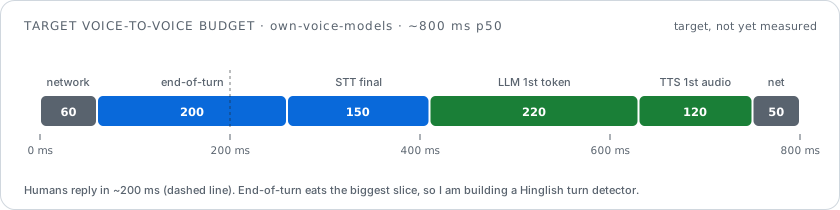
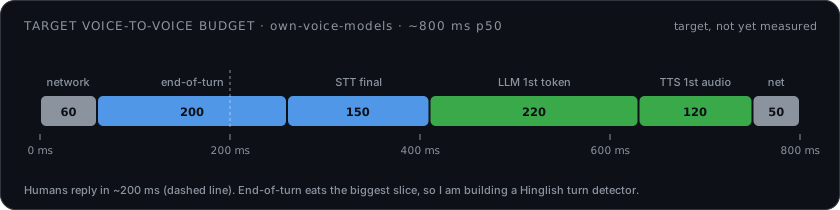
| Stage | Target | Why it gets that slice |
|---|---|---|
| Network in | 60 ms | WebRTC, nearest region |
| End-of-turn | 200 ms | The biggest slice, and the hardest to cut safely |
| STT final | 150 ms | Streaming ASR, so most text exists before the turn ends |
| LLM first token | 220 ms | Small LoRA-tuned model, INT8, speculative decoding |
| TTS first audio | 120 ms | Stream the first phrase, don't wait for the full reply |
| Network out | 50 ms | Same path back |
| Total | ~800 ms |
End-of-turn is the real bottleneck
Look at the budget again: the largest slice is not a model at all. It is deciding that the caller has stopped talking.
Wait too little and you interrupt people mid-thought, which on Hindi calls already happens. Wait too long and every reply feels slow. A fixed silence timeout cannot win both ways, especially in code-mixed Hinglish where pauses fall in different places.
That is why the first model I'm building is a small Hinglish turn detector that predicts the end of a turn instead of waiting for silence, based on Voice Activity Projection. Target: ~30% fewer false interruptions than VAD alone.
The rest of the stack
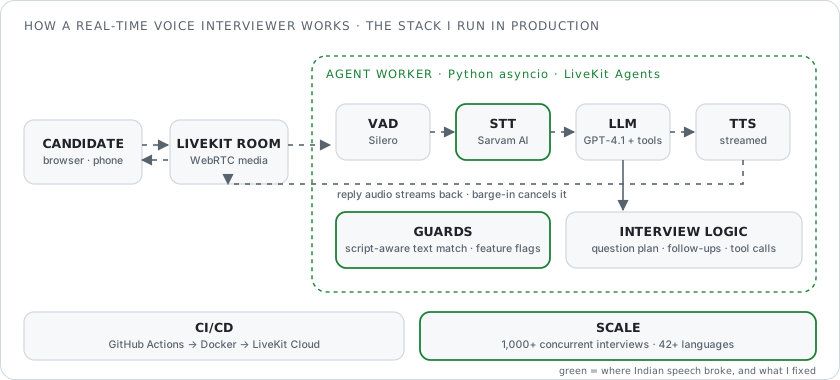
- STT: a Hindi/Marathi ASR model I'm training, following Whisper and Conformer + RNN-T for streaming.
- LLM: a small model tuned with LoRA, quantised to INT8, with speculative decoding for a faster first token.
- TTS: a Hindi voice following StyleTTS 2, streamed phrase by phrase.
- Orchestrator: written from scratch in Python asyncio: VAD, end-of-turn, barge-in, and cancelling a reply the moment the caller speaks.
How I'll know it worked
Each stage gets its own timer, per language, in every session, so a regression shows up as "Hindi TTS first audio got slower" instead of "calls feel slow". The second target is cost: ~5× lower cost per minute than hosted APIs, by running the models myself.
Targets: ~800 ms p50 voice-to-voice, ~5× lower cost/min. Status: in progress. Follow along on GitHub.